📰 This article is based on reporting from Reuters (September 29, 2026), The Guardian (October 7, 2026), Associated Press (October 6, 2026), and CNBC. The lawsuit's allegations have not been established by a court. McDonald's denies the claims.
McDonald's Sued Over AI Pricing: Could an Algorithm Be Fixing Your Big Mac's Price?
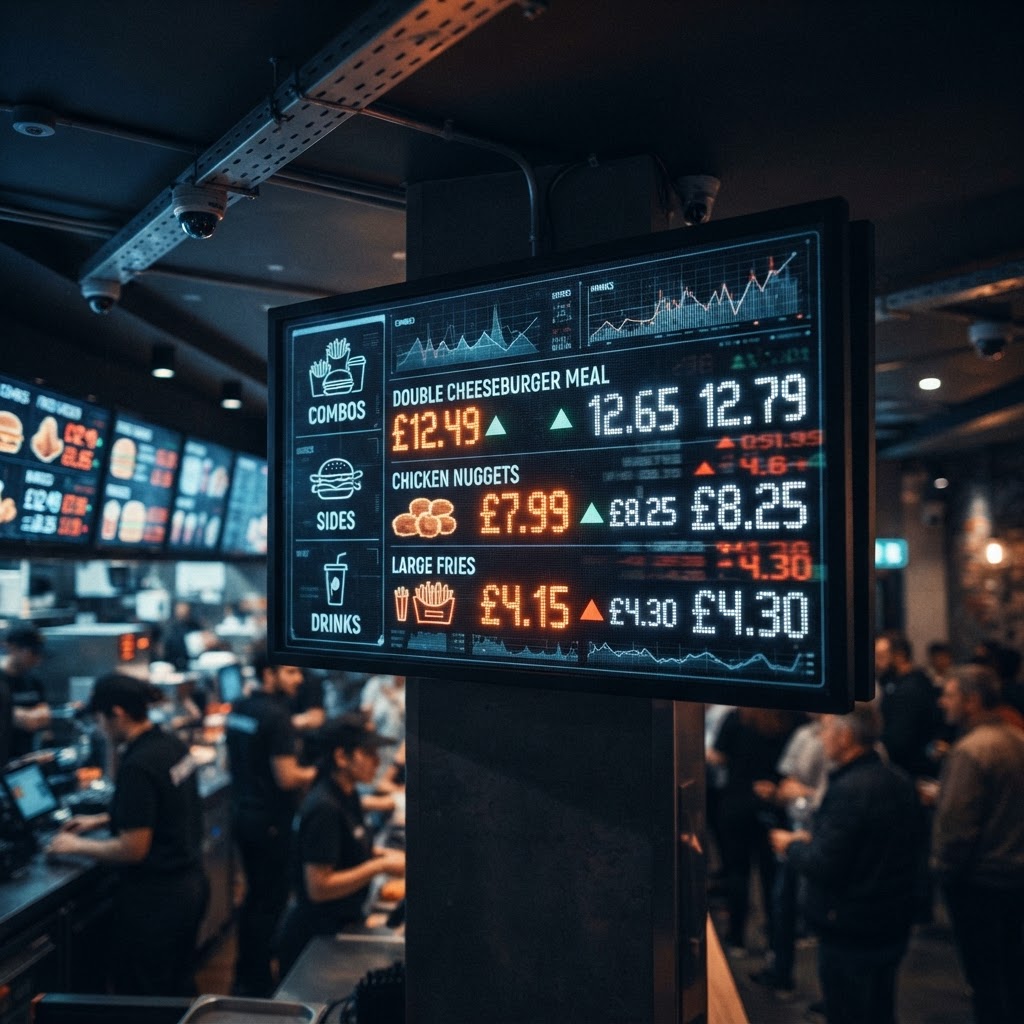
Next time you notice the price of a Big Mac seems higher than it used to be, the reason might involve artificial intelligence. McDonald's is facing a proposed nationwide class action lawsuit in federal court in Chicago, alleging that the fast-food giant uses an AI-powered pricing system to illegally coordinate menu prices across its franchise and company-owned restaurants, in violation of US antitrust law.
What Reuters Found
The lawsuit follows a Reuters investigation published on September 29, 2026, which revealed that McDonald's uses machine-learning algorithms to recommend menu prices at individual restaurant level across its nearly 14,000 US locations. Reuters reviewed screenshots of the pricing system and spoke with nine people with firsthand knowledge.
The system analyses millions of daily transactions and estimates local customers' willingness to pay, then recommends item-level prices for each restaurant. Reuters reporters visited two company-run McDonald's locations roughly two miles apart in Fresno, California, and found a 21% price difference for a Big Mac: $5.69 at one and $6.89 at the other.
Reuters could not establish whether that specific price difference was caused by the AI recommendation engine, but the investigation raised serious questions about transparency and whether franchisees feel pressured to follow the algorithm's suggestions.
The Lawsuit: AI as a Price-Fixing Tool
The class action lawsuit was filed on October 5, 2026, in the US District Court for the Northern District of Illinois. The plaintiff, an Illinois resident, is seeking to represent a class of potentially millions of McDonald's customers.
The core legal argument is that McDonald's sharing of its AI pricing recommendations with both company-owned and independently franchised restaurants effectively turns what should be independent pricing decisions into coordinated ones. Under US antitrust law, independent businesses are supposed to set their prices independently. When a franchisor shares nonpublic pricing data with franchisees through an algorithm, the lawsuit argues, that independence disappears.
Lark Turner, a lawyer for the plaintiff, said in a statement that McDonald's is "leveraging its troves of data and its franchised system to nickel-and-dime consumers down to the last French fry."
McDonald's Response: "AI Does Not Set the Price of a Big Mac"
McDonald's has pushed back firmly. In a statement issued on October 6, the company called the allegations "speculative and uninformed."
"AI does not set the price of a Big Mac or any other menu item," McDonald's said. The company maintains that its pricing tool is a recommendation system, not a mandate, and that franchisees make their own pricing decisions. It also noted that pricing recommendation tools and analytics are widespread across industries.
Why This Case Matters Beyond Fast Food
This lawsuit is part of a growing wave of antitrust class actions targeting algorithmic and AI-driven pricing. Similar cases have been filed in recent years alleging that companies used algorithms to illegally coordinate prices for hotel rooms, apartment rentals, and other goods and services.
The McDonald's case is significant for three reasons:
1. Scale. With nearly 14,000 US restaurants and millions of daily transactions, the amount of data feeding the AI pricing engine is enormous. If the court allows the case to proceed, it could set a precedent for how large franchise networks use AI to influence pricing.
2. The franchise model. Antitrust law distinguishes between a company setting prices for its own stores and coordinating prices across independent franchisees. The lawsuit argues that sharing AI-generated recommendations across that boundary crosses a legal line.
3. Transparency. Most consumers have no idea that the price they pay at a drive-through might be influenced by a machine-learning model analysing their local purchasing behaviour. The case could force greater transparency about how AI shapes everyday prices.
What It Means for You
If you eat at McDonald's or any major franchise, this case could eventually affect how prices are set and disclosed. But do not expect immediate changes. Class action lawsuits of this scale typically take years to resolve, and McDonald's will likely fight hard to get the case dismissed.
In the meantime, it is worth paying attention to price differences between locations of the same chain. If a Big Mac costs significantly more at one restaurant than another nearby, an AI pricing engine may be at work.
For those interested in understanding how AI is reshaping business and consumer rights, these books are a good starting point:
The Bigger Picture
The McDonald's lawsuit is a reminder that AI is not just a story about chatbots and image generators. It is quietly embedded in the systems that determine what we pay for everyday goods and services. From ride-hailing surge pricing to airline seat selection to fast-food menu prices, algorithms are increasingly making commercial decisions that used to be made by humans.
That is not inherently a problem. Dynamic pricing can reflect real differences in costs, demand, and local market conditions. But when AI pricing systems operate across franchise networks with shared data, the line between smart pricing and illegal price coordination becomes much harder to draw.
The courts may now have to decide where that line sits.
The Bottom Line
McDonald's faces a class action alleging its AI pricing system illegally coordinates menu prices across franchises. The company denies the claims and says franchisees set their own prices. The case is in its earliest stages, but it raises questions that go well beyond the price of a burger: when AI recommends prices across thousands of locations, is that a helpful tool or a new form of price-fixing?
Sources: Reuters (September 29, 2026), The Guardian (October 7, 2026), Associated Press (October 6, 2026), CNBC. Allegations have not been proven in court.