📰 This article is based on reporting by Al Jazeera (published October 16, 2026) and Newsweek (published October 15, 2026) on Tesla's livestreamed Roadster reveal. The flight features shown were prototype demonstrations only — production is not expected until 2028, and no flying capability has been approved for public roads. The airborne stunts below were performed in a controlled environment at a test site.
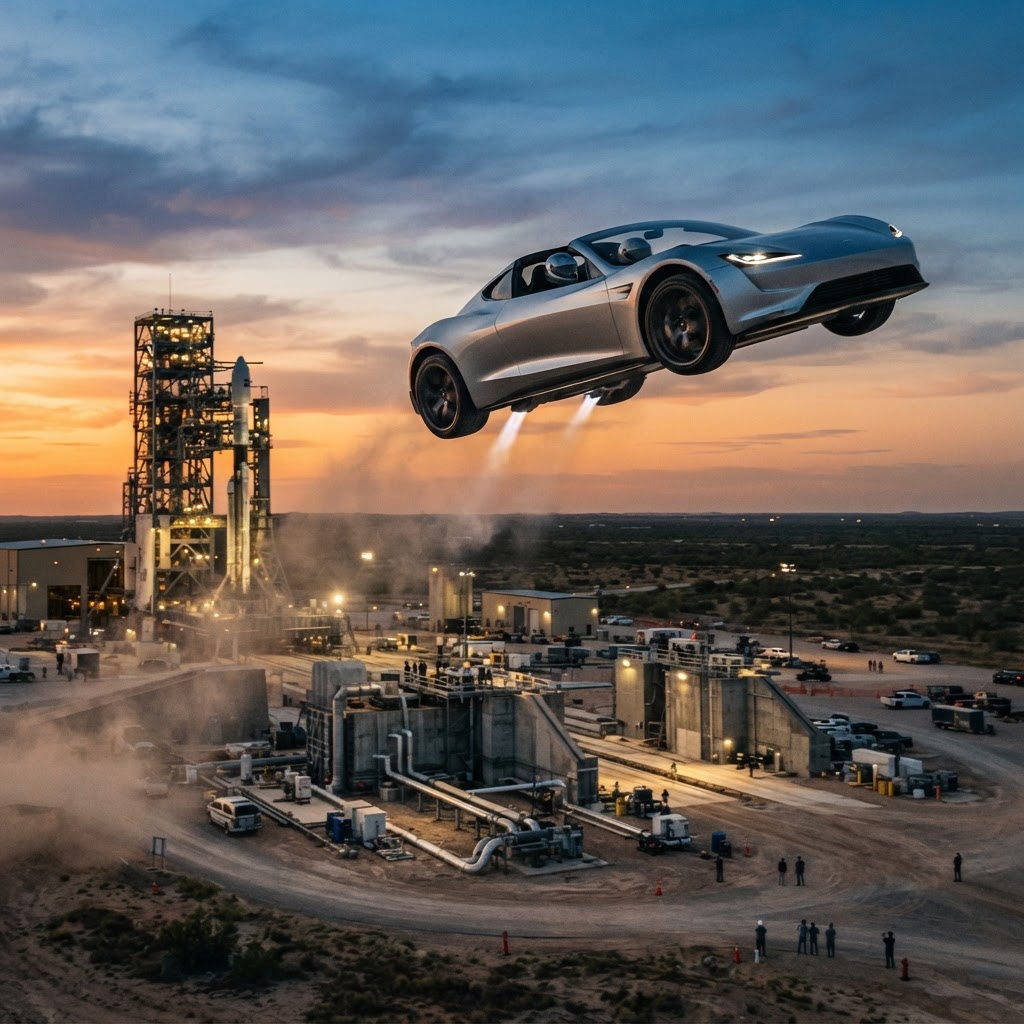
Yes, it's a real video: Tesla's next-generation Roadster, unveiled on October 15 at SpaceX's rocket test facility in McGregor, Texas, drove upside down on a curved ramp, fired cold-gas thrusters, and leapt and flipped through the air — with Elon Musk calling it "better than any James Bond car."
The long-delayed "flying" Roadster is finally, demonstrably, a thing. Here's what Tesla actually showed, what it means, and the many caveats attached.
What Tesla Actually Showed
The livestreamed event, held on a SpaceX test site and presented by Musk, Tesla design chief Franz von Holzhausen and vice president of vehicle engineering Lars Moravy, featured the Roadster performing stunts that no production car has ever attempted publicly:
- Driving upside down on a curved ramp, carried by momentum
- Cold-gas thruster jumps — rocket-inspired, SpaceX-derived thrusters that let the car hop and turn mid-air
- A claimed 0–60 mph time of under one second
- Momentary above-ground hovering, the clip that lit up social media with 1.7 million views in a day
Musk was characteristically blunt about the engineering risk: "Success is not guaranteed. It'll probably work, but if it doesn't work, we're at a safe distance. Excitement is 100 percent guaranteed." He also admitted the demonstrator wasn't necessarily "safety optimized."
A Promise Nine Years Old
This reveal is the payoff to one of Musk's longest-running teases. The second-generation Roadster was first unveiled in 2017 with the promise of a SpaceX thruster package, and reservations opened then — with the base car listed at $200,000 and a limited Founders Series at $250,000. Nearly a decade later, production is now expected to begin in 2028. Tesla has not announced updated pricing, and analysts expect a substantially higher ticket given the delays, inflation and the added SpaceX hardware.
Can You Actually Fly It? Almost Certainly Not on Public Roads
Here's the sober part. Under US Federal Aviation Administration rules, anything that flies above the ground is generally classified as an aircraft — and separate regulations already exist for eVTOL vehicles. Experts quoted ahead of the launch suggested the Roadster's aerial functions, if they survive to production, would likely be restricted to controlled environments rather than hovering over your local high street.
Notably, flight restrictions were established around the Texas test site before the demonstration — a hint that regulators were already treating the stunt as aviation, not automotive.
Why It Matters Anyway
Strip away the stunts and the Roadster is a serious engineering statement: a collaboration between, in Musk's words, "the world's best car company and the world's best rocket company." Compressing a 0–60 sprint into under a second would require thruster assist — physics that conventional supercars, electric or otherwise, cannot touch.
For everyone who won't be on the 2028 reservation list, the practical takeaway is smaller: electric performance keeps trickling down. Today's mainstream EVs already deliver supercar-silencing acceleration for family-car money, and the right home charger matters more to daily EV life than any thruster. And if you already own a Tesla, the accessory ecosystem is where the real-world fun is affordable.
The Bottom Line
A flying, flipping, upside-down-driving Roadster is real — as a prototype, on a rocket test site, with production promised for 2028 and regulators yet to have their say. Given this project's nine-year history of delays, treat the calendar with healthy skepticism. But as an engineering demonstration, October 15 delivered exactly what Musk promised: excitement, 100 percent guaranteed.
Some links above are affiliate links, which may earn ZazzyTech a small commission at no extra cost to you. As an Amazon Associate, ZazzyTech earns from qualifying purchases.
